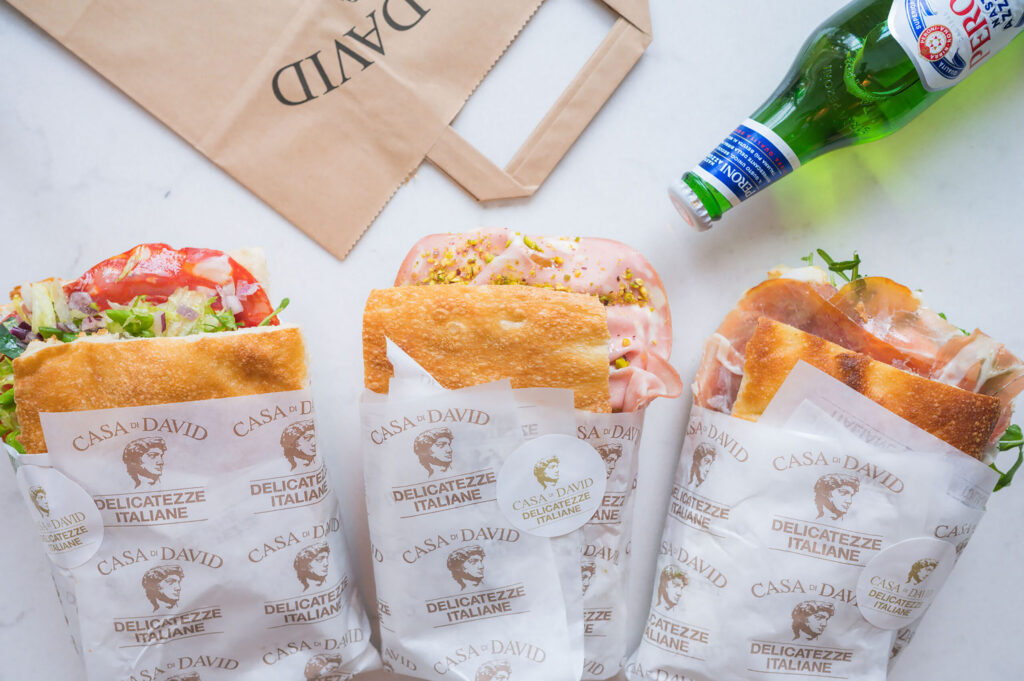
If you are looking for the best focaccia in Amsterdam, head to Casa di David Deli at Singel 434, right next to our main restaurant. Every morning, David himself bakes fresh focaccia from scratch using traditional Italian methods, and the result is exactly what good focaccia should be: golden, airy, fragrant, and full of flavour. Whether you want a quick bite to go or a starter at the table, this is the real thing. Below, we answer all the questions you might have about authentic Italian focaccia.
Where can you find authentic Italian focaccia in Amsterdam?
Authentic Italian focaccia in Amsterdam is harder to find than you might think. Most versions you encounter are too thick, too bready, or missing that distinctive olive oil richness that defines the real thing. At Casa di David, we bake our focaccia fresh every morning at our corner deli at Singel 434, directly next to the main restaurant. It has become one of the most talked-about things we make, and guests keep coming back for it.
Our deli is a relaxed, grab-and-go spot where you can pick up focaccia alongside a coffee, other Italian favourites, and a genuine slice of Italian hospitality in the middle of Amsterdam. Regulars know to arrive early, because it sells out.
What makes focaccia truly authentic?
Truly authentic focaccia is defined by three things: high-quality olive oil, a slow fermentation process, and a light, open crumb. It should be golden on the outside, soft and airy on the inside, and generously dressed with good extra virgin olive oil before and after baking. Authentic focaccia is never dense or dry.
The Italian tradition of focaccia goes back centuries and varies by region. In Liguria, the classic version is thin and crispy with a strong olive oil flavour. In Puglia, it tends to be thicker and topped with tomatoes and olives. What all authentic versions share is simplicity: flour, water, yeast, salt, and olive oil, done with care and patience.
What makes the difference in practice is the dough. A proper focaccia dough is well-hydrated and given enough time to develop flavour. Shortcuts produce flat, lifeless bread. Respect for the process produces something worth eating.
How is focaccia different from pizza dough?
Focaccia and pizza dough share similar ingredients, but they are not the same thing. Focaccia dough contains more olive oil and more water, which gives it a softer, spongier texture. Pizza dough is leaner and designed to be stretched thin, creating a crispier base. The two breads are related but serve entirely different purposes at the Italian table.
Another key difference is how they are baked. Focaccia is typically baked in a deep pan and dimpled with fingertips before going into the oven, allowing olive oil to pool in the dough and create its characteristic texture. Pizza is stretched flat and baked quickly at very high heat on a stone or in a wood-fired oven.
Focaccia is also more forgiving as a standalone bread. It holds its own as a snack, a starter, or even a light meal, whereas pizza is built around its toppings.
What toppings go on traditional Italian focaccia?
Traditional Italian focaccia toppings are simple and ingredient-led. The most classic version is topped with nothing more than coarse sea salt, rosemary, and a generous pour of extra virgin olive oil. From there, regional traditions add their own character.
- Rosemary and sea salt: the most traditional and widely loved combination
- Cherry tomatoes and olives: common in southern Italian versions, especially from Puglia
- Caramelised onions: sweet and savoury, particularly popular in Liguria
- Sliced potato and rosemary: a hearty, rustic variation from central Italy
- Sage and garlic: aromatic and warming, often found in home kitchens
The golden rule with focaccia toppings is restraint. Italian cooking at its best is about letting good ingredients speak for themselves, not piling on flavours until nothing stands out. A well-made focaccia with rosemary and salt needs nothing else.
Should focaccia be served as a starter or a main dish?
In Italian tradition, focaccia is most commonly served as a starter, a snack, or alongside a meal rather than as a main dish. It appears on the table before the meal begins, used to accompany antipasti or simply enjoyed on its own while the kitchen gets going. That said, a generous slice of well-topped focaccia can absolutely serve as a light lunch.
In Italy, focaccia is also eaten throughout the day. In Liguria, it is a common breakfast food, eaten warm with a coffee in the morning. In other regions, it is a mid-morning snack or a quick bite between meals. The point is that focaccia is versatile and unpretentious, which is exactly what makes it so beloved.
At our deli, we serve focaccia as a grab-and-go option throughout the day, and it also features as a starter in the main restaurant. Both work beautifully.
Why does a wood-fired oven make better focaccia?
A wood-fired oven produces better focaccia because of the intense, even heat it generates and the slight smokiness it imparts to the bread. The high temperature creates a crispy, golden crust quickly while keeping the inside soft and airy. Conventional ovens simply cannot replicate this combination of speed and heat distribution.
Wood-fired baking also affects the crust in a specific way. The radiant heat from the stone floor and the dome of the oven surrounds the bread from all sides, giving it an even colour and a texture that is hard to achieve otherwise. The result is focaccia that has real character: a crust with bite and an interior that stays tender.
At Casa di David, our wood-fired oven has been central to our kitchen since the beginning. The same oven that produces our handmade pizzas also brings out the best in our bread. You can view our full menu to see how we use it across the whole kitchen.
What should you drink with focaccia at an Italian restaurant?
The best drinks to pair with focaccia at an Italian restaurant are those that complement its olive oil richness without overpowering its simplicity. A glass of light, crisp Italian white wine such as Vermentino or Pinot Grigio works beautifully. If you prefer something non-alcoholic, sparkling water with lemon is the classic Italian choice.
For focaccia served as a starter before a full Italian meal, keep the drink light so it does not overshadow the courses ahead. A small glass of Prosecco is a festive and perfectly Italian way to begin. If you are enjoying focaccia as a midday snack, an espresso or a macchiato in true Italian style is completely appropriate and deeply satisfying.
The key is not to overthink it. Focaccia is everyday Italian food, and the drinks that go with it should feel just as natural and unfussy.
How Casa di David brings focaccia to the table
Our focaccia is one of those things that guests mention again and again. It is baked fresh each morning by David himself, using traditional Italian methods and quality ingredients. It is the kind of bread that reminds you why simple things done well are always the most satisfying.
- Freshly baked every morning at Casa di David Deli at Singel 434
- Made using a traditional Italian recipe with high-quality olive oil
- Available to take away from the deli or as a starter in the main restaurant
- Baked in our wood-fired oven for that characteristic crust and soft interior
- Part of a 50-year tradition of authentic Italian cooking in the heart of Amsterdam
Whether you stop by the deli for a quick bite on your way through the city or settle in for a full dinner on the canal, the focaccia is always worth it. We would love to have you. Book your table and come and taste it for yourself.